
W' Balance
1. What is W′ Balance?
W′ (W prime) represents the amount of work you can perform above your Critical Power (CP). Think of it as your anaerobic energy reserve.
W′ Balance (W′bal) estimates how much of that reserve remains throughout a workout.
Above CP: W′ is depleted.
Below CP: W′ begins to recover.
Near zero: Your ability to sustain hard efforts becomes limited.
By tracking this process second-by-second, W′ Balance helps you understand how much high-intensity capacity you have available at any moment.
2. How Vekta Calculates W′ Balance
Vekta estimates your W′ from your Critical Power model and continuously updates your W′ Balance during every session.
Power above CP: W′ decreases.
Power below CP: W′ gradually recovers.
Lower recovery intensity: Faster replenishment.
This provides a real-time view of your anaerobic "battery" and helps answer questions such as:
Can I push now, or should I recover longer?
How many hard intervals can I still complete?
Is it the right time to attack in a race?
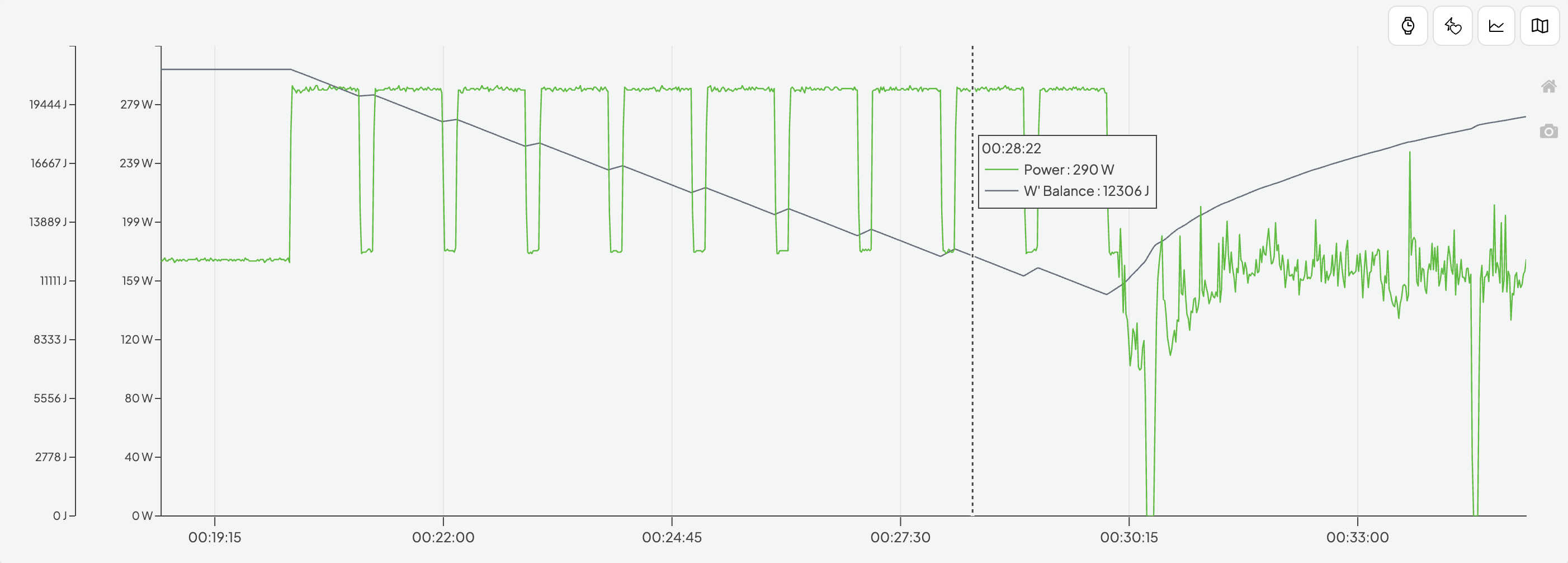
3. Why Can W′ Balance Go Negative?
W′ Balance is a physiological model, not a direct measurement.
In some cases, the model may show negative values:
You may recover faster than the model predicts.
Your true W′ may be larger than estimated.
Fatigue, illness, or poor recovery can change your actual capacity.
Negative values don't mean you've exceeded your physiological limits. They simply highlight the limitations of modeling a complex system.
4. Practical Uses
Pacing
Avoid going all-in when W′ is nearly depleted.
Time hard efforts more effectively.
Interval Training
Design intervals with appropriate recovery periods.
Target anaerobic adaptations without excessive fatigue.
Racing
Monitor when you have enough reserve for decisive efforts.
Avoid burning through your anaerobic capacity too early.
The Bottom Line
W′ Balance turns your anaerobic capacity into a visible and actionable metric. By showing how your high-intensity reserve is spent and replenished, it helps you pace workouts, execute races, and better understand why you succeeded, or why you ran out of gas.
Further Reading
Skiba, P. F., & Clarke, D. C. (2021). The W' Balance Model: Mathematical and Methodological Considerations. International journal of sports physiology and performance, 16(11), 1561–1572. https://doi.org/10.1123/ijspp.2021-0205
Bartram, J. C., Thewlis, D., Martin, D. T., & Norton, K. I. (2018). Accuracy of W' Recovery Kinetics in High Performance Cyclists-Modeling Intermittent Work Capacity. International journal of sports physiology and performance, 13(6), 724–728. https://doi.org/10.1123/ijspp.2017-0034
Bartram, J. C., Thewlis, D., Martin, D. T., & Norton, K. I. (2022). Validating an Adjustment to the Intermittent Critical Power Model for Elite Cyclists-Modeling W' Balance During World Cup Team Pursuit Performances. International journal of sports physiology and performance, 17(2), 170–175. https://doi.org/10.1123/ijspp.2020-0444
Welburn, A.J., Pugh, C.F., Bailey, S.J. et al. W′ reconstitution modelling during intermittent exercise performed to task failure. Eur J Appl Physiol (2025). https://doi.org/10.1007/s00421-025-05912-0